Your Essential Art History Timeline for Beginners

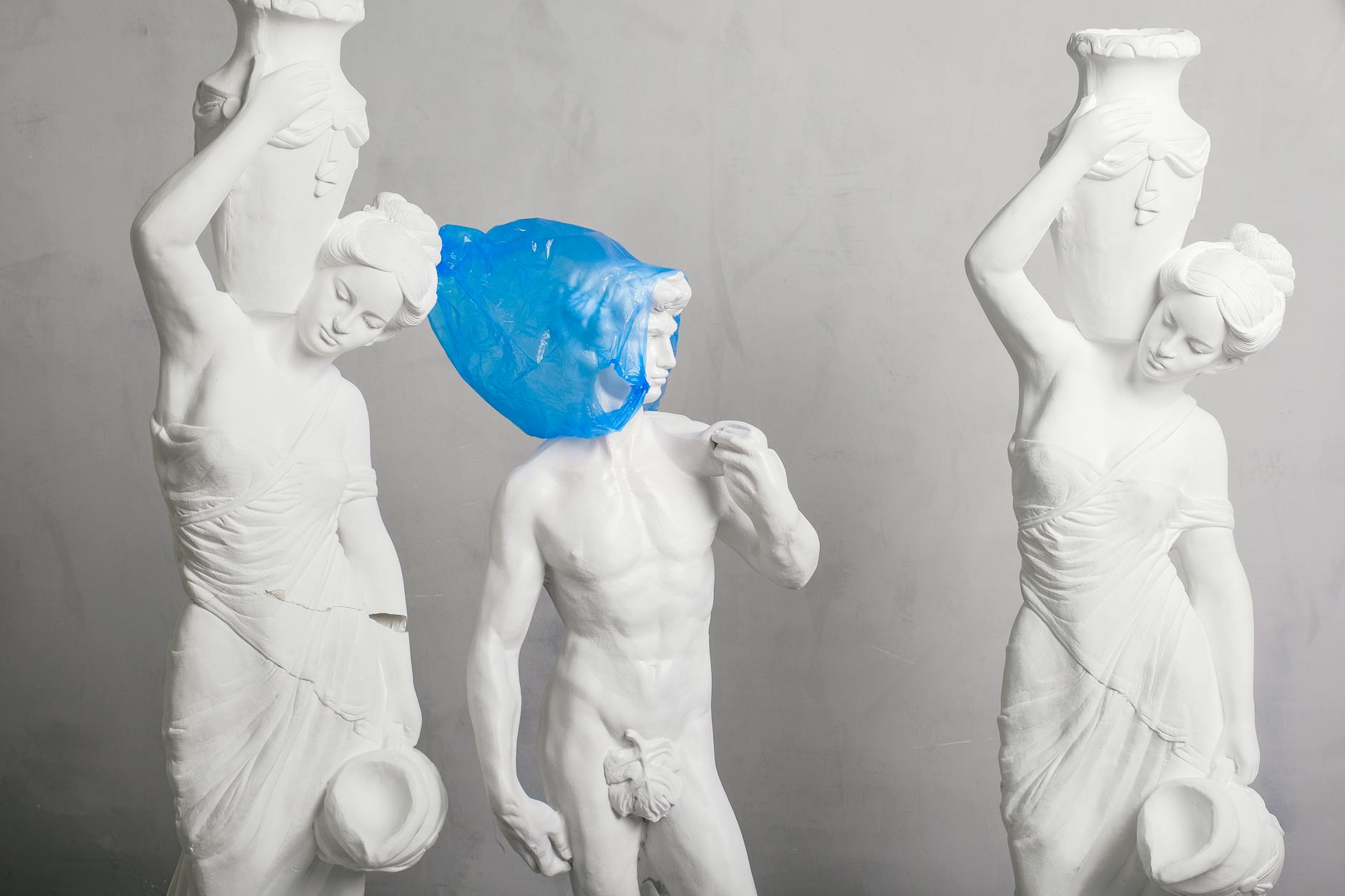
Greek marble statues adorned with a contrasting blue plastic bag conveying environmental themes.Photo: Anna Shvets / Pexels

Your Essential Art History Timeline for Beginners

Embark on an inspiring journey through millennia of human creativity, from ancient caves to contemporary canvases.

Start Your Art Journey

Key Takeaways

  • ✓ Art history spans over 40,000 years, beginning with prehistoric cave paintings.
  • ✓ Major art movements often reflect societal changes, technological advancements, and philosophical ideas.
  • ✓ Understanding the timeline helps contextualize artworks and appreciate their significance.
  • ✓ The Renaissance marked a pivotal shift towards humanism and naturalism in art.

How It Works

1
Explore Epochs

Our timeline breaks down art history into digestible epochs, making complex periods easy to understand. Each epoch highlights the defining characteristics and major artists.

2
Discover Key Movements

Dive into specific art movements like Impressionism, Cubism, and Pop Art. Learn about their origins, stylistic innovations, and lasting impact on the art world.

3
Meet Influential Artists

Get acquainted with the masterminds behind iconic works. From Leonardo da Vinci to Frida Kahlo, understand their contributions and artistic legacies.

4
Build Your Knowledge

By following this structured timeline, you'll gain a foundational understanding of art history. This knowledge enhances your appreciation of art in museums, galleries, and everyday life.

The Dawn of Creativity: Prehistoric and Ancient Art
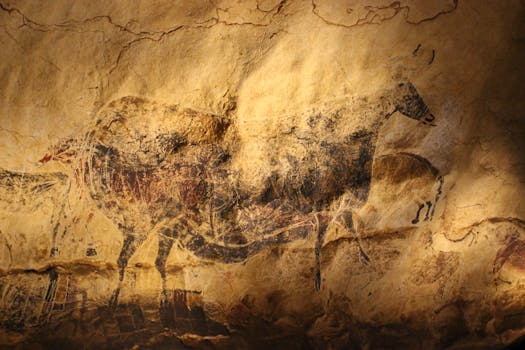
Explore the historic Lascaux cave painting, a UNESCO World Heritage site.Photo: toshihiko tanaka / Pexels
Imagine a world without written language, where stories were etched onto cave walls and beliefs carved into stone. This is where our art history timeline for beginners truly begins, in the vast expanse of prehistory, dating back tens of thousands of years. The earliest forms of art, like the breathtaking cave paintings of Lascaux, France, and Altamira, Spain, speak volumes about the lives, rituals, and fears of our ancient ancestors. These powerful images of animals—bison, horses, deer—were not merely decorative; they likely served magical or religious purposes, perhaps to ensure a successful hunt or to connect with spiritual forces. The artists, working in the dim light of flickering torches, used natural pigments derived from minerals and charcoal, applying them with their fingers, moss, or rudimentary brushes. This period, roughly from 40,000 BCE to 3,000 BCE, lays the groundwork for all subsequent human artistic expression, demonstrating an innate human desire to create and communicate visually. Moving forward, we enter the era of Ancient Civilizations, a period of monumental shifts in human society and artistic development. From around 3000 BCE to 500 CE, powerful empires rose and fell, leaving behind an astonishing legacy of art and architecture. Ancient Egyptian art, characterized by its strict conventions, symbolism, and focus on the afterlife, gave us the majestic pyramids, intricate tomb paintings, and the iconic gold mask of Tutankhamun. Their art was designed for eternity, with figures often depicted in composite view—a combination of frontal and profile perspectives—to convey all essential information. The Greeks, known for their pursuit of ideal beauty, harmony, and proportion, revolutionized sculpture with their lifelike depictions of the human form, moving from rigid Archaic kouroi to the dynamic, naturalistic figures of the Classical period. Think of the Parthenon's elegant architecture and the serene beauty of the Venus de Milo. Roman art, while heavily influenced by Greek aesthetics, distinguished itself through its emphasis on realism, portraiture, and engineering marvels like the Colosseum and intricate mosaics. The Romans were masters of propaganda, using art to glorify their emperors and empire. Both Greek and Roman art profoundly influenced Western aesthetics for centuries to come, establishing principles of balance, order, and anatomical accuracy. This early foundation of human creativity, from the primal urges of cave dwellers to the sophisticated expressions of ancient empires, reveals the enduring power of art to reflect, shape, and transcend human experience. Understanding these foundational periods is crucial for anyone embarking on an art history timeline for beginners, as they set the stage for all that follows. Explore more ancient art and its impact.

The Middle Ages and the Renaissance Rebirth

Following the fall of the Roman Empire, Europe entered a period often referred to as the Middle Ages (roughly 500 CE to 1400 CE), a time of profound religious devotion and artistic innovation, though often mislabeled as 'dark.' Early Christian art emerged, adapting Roman forms to express new spiritual narratives, seen in catacomb paintings and early basilicas. Byzantine art, centered in Constantinople, developed a distinct style characterized by shimmering mosaics, flattened figures, and a heavenly gold backdrop, emphasizing the spiritual rather than the earthly. Icons, revered images of saints and religious figures, became central to worship. Later, Romanesque art (c. 1000-1200 CE) saw the construction of massive stone churches adorned with relief sculptures, often depicting biblical scenes for a largely illiterate populace. This gave way to the soaring heights and ethereal light of Gothic art (c. 1150-1400 CE), exemplified by magnificent cathedrals like Chartres and Notre Dame. With their pointed arches, ribbed vaults, and vast stained-glass windows, these structures aimed to elevate the worshipper toward the divine, creating an immersive, spiritual experience unlike anything seen before. Figures in Gothic sculpture began to show more naturalism and emotional depth, signaling a gradual shift towards human-centered expression. Then came the astonishing period of the Renaissance (roughly 1400-1600 CE), a 'rebirth' of classical ideals and a profound cultural, artistic, and intellectual blossoming that began in Italy. This era marked a decisive break from medieval traditions, placing a new emphasis on humanism, individualism, and scientific inquiry. Artists like Masaccio pioneered linear perspective, creating convincing illusions of three-dimensional space on a two-dimensional surface. Donatello rediscovered the free-standing nude sculpture, imbued with classical grace and psychological depth. The High Renaissance (c. 1490-1527) saw the emergence of titans: Leonardo da Vinci, the ultimate Renaissance man, whose Mona Lisa and The Last Supper are testaments to his mastery of chiaroscuro and psychological insight; Michelangelo, whose David and the Sistine Chapel ceiling redefine monumental sculpture and painting; and Raphael, celebrated for his harmonious compositions and serene Madonnas. Across Europe, artists absorbed and adapted these innovations. In the Northern Renaissance, artists like Jan van Eyck and Albrecht Dürer focused on meticulous detail, rich symbolism, and the exploration of everyday life and portraiture through the mastery of oil paint. The Renaissance was a period of intense experimentation and discovery, fundamentally altering the course of Western art and setting new standards for artistic excellence, making it a cornerstone of any art history timeline for beginners. Its influence on subsequent movements is immeasurable, as artists continued to build upon its innovations in perspective, anatomy, and emotional expression.

Baroque to Romanticism: Drama, Emotion, and Revolution

The 17th and 18th centuries witnessed the dramatic flair of the Baroque and the refined elegance of Rococo, followed by the intellectual rigor of Neoclassicism and the passionate intensity of Romanticism. The Baroque period (c. 1600-1750), emerging from Rome, was a response to the Protestant Reformation and a celebration of the Catholic Church's power and grandeur. Art of this era is characterized by intense drama, rich colors, deep shadows (chiaroscuro), and dynamic compositions. Think of the swirling energy of Bernini’s Ecstasy of Saint Teresa, the emotional gravitas of Caravaggio’s tenebrism, or the opulent, theatrical ceilings painted by artists like Peter Paul Rubens. In the Netherlands, artists like Rembrandt and Vermeer explored domestic scenes, portraiture, and light with unparalleled sensitivity, though often categorized separately as Dutch Golden Age painting, it shares many Baroque characteristics. This period aimed to evoke strong emotions and awe in the viewer. As the Baroque gave way, the Rococo style (c. 1730-1770) emerged, primarily in France, reflecting the tastes of the aristocracy. It was lighter, more playful, and decorative, favoring pastel colors, curvilinear forms, and themes of love, leisure, and frivolity. Works by artists like Fragonard and Watteau exemplify this delicate, intimate aesthetic. However, the frivolity of Rococo was soon challenged by the Enlightenment's emphasis on reason and classical ideals. Neoclassicism (c. 1750-1850) became the dominant style, drawing inspiration directly from ancient Greece and Rome. It championed order, clarity, and moral virtue, often serving as a visual metaphor for the revolutionary fervor sweeping Europe and America. Jacques-Louis David's 'Oath of the Horatii' is a prime example, with its stoic heroes and crisp lines. This period sought to revive the perceived purity and heroism of antiquity. In stark contrast, Romanticism (c. 1800-1850) erupted as a powerful reaction against the perceived cold rationality of Neoclassicism. Romantics prioritized emotion, individualism, the sublime in nature, and the exotic. Artists like Eugène Delacroix depicted dramatic historical events with vibrant color and energetic brushwork, while J.M.W. Turner captured the raw power of nature in his atmospheric landscapes. Francisco Goya, with his searing social commentary and dark visions, also embodies the Romantic spirit. This period celebrated the wild, the mysterious, and the personal experience, laying the groundwork for even more radical artistic departures. From the grandeur of Baroque to the intimate charm of Rococo, the moral rectitude of Neoclassicism, and the passionate outbursts of Romanticism, these centuries are a vibrant tapestry of evolving artistic expressions, crucial for anyone delving into an art history timeline for beginners. Each movement, though distinct, contributed layers to the ongoing dialogue of human creativity.

Modern and Contemporary Art: Breaking Boundaries and Redefining Art

The late 19th century ushered in an era of unprecedented artistic experimentation and a rapid succession of groundbreaking movements that collectively form the bedrock of Modern Art (roughly 1860s-1970s). It all began with Impressionism, a radical departure from academic tradition, as artists like Claude Monet sought to capture fleeting moments of light and color, painting en plein air. Post-Impressionists like Vincent van Gogh, Paul Cézanne, and Paul Gauguin then pushed these ideas further, emphasizing emotion, structure, and symbolism. Cubism, pioneered by Pablo Picasso and Georges Braque, shattered traditional perspective, depicting objects from multiple viewpoints simultaneously. Futurism celebrated technology and speed, while Surrealism, led by André Breton and artists like Salvador Dalí, explored the subconscious mind and dreamscapes. Each movement challenged previous norms, reflecting the rapid industrial, social, and psychological changes of the era. After World War II, the art world shifted its center to New York, giving rise to Abstract Expressionism, an intensely emotional and gestural style exemplified by Jackson Pollock's drip paintings and Mark Rothko's color fields. This was followed by Pop Art in the 1960s, which embraced popular culture and consumerism, with Andy Warhol's iconic silk screens of Campbell's soup cans and Marilyn Monroe. Minimalism stripped art down to its essential forms, while Conceptual Art prioritized ideas over aesthetics. The latter part of the 20th century and the beginning of the 21st century have seen the emergence of Contemporary Art (1970s-present), a highly diverse and often challenging landscape where traditional categories are blurred. Artists explore themes of identity, globalization, technology, and environmental concerns through an ever-expanding range of media, from video installations and performance art to digital creations and bio-art. There is no single dominant style; instead, contemporary art is characterized by its pluralism and willingness to question the very definition of art itself. This journey through modern and contemporary art reveals a continuous quest for innovation and a desire to reflect and respond to an increasingly complex world. For anyone exploring an art history timeline for beginners, understanding these periods is vital to grasping the trajectory of artistic thought and expression into the present day. It's a dynamic, ongoing story where the only constant is change, inviting viewers to engage critically and personally with the art they encounter. **Key Modern & Contemporary Movements to Explore:** * **Impressionism:** Monet, Renoir, Degas * **Post-Impressionism:** Van Gogh, Cézanne, Gauguin * **Cubism:** Picasso, Braque * **Surrealism:** Dalí, Magritte, Miró * **Abstract Expressionism:** Pollock, Rothko, de Kooning * **Pop Art:** Warhol, Lichtenstein, Oldenburg * **Minimalism:** Judd, Serra, Flavin * **Conceptual Art:** Kosuth, Weiner * **Contemporary Practices:** Ai Weiwei, Yayoi Kusama, Banksy

Comparison

Art PeriodKey CharacteristicRepresentative ArtistTypical Medium
PrehistoricSurvival, RitualAnonymous Cave PainterCave paintings, carvings
Ancient EgyptAfterlife, ImmortalitySculptors for PharaohsSculpture, wall paintings
Greek ClassicalIdeal Beauty, HarmonyPhidiasMarble sculpture
Roman EmpireRealism, PropagandaAnonymous Roman SculptorBusts, frescoes
GothicDivine Light, Soaring FormsMaster Mason of ChartresStained glass, architecture
RenaissanceHumanism, PerspectiveLeonardo da VinciOil painting, fresco
BaroqueDrama, EmotionCaravaggioOil painting, sculpture
RococoPlayfulness, OrnamentationFragonardPastel oil paintings
NeoclassicismOrder, MoralityJacques-Louis DavidOil painting, sculpture
RomanticismEmotion, NatureEugène DelacroixOil painting
ImpressionismLight, Momentary EffectClaude MonetOil painting
CubismMultiple PerspectivesPablo PicassoOil painting, collage
Pop ArtPopular CultureAndy WarholSilk screen, mixed media
ContemporaryDiverse, ConceptualYayoi KusamaInstallation, digital, mixed media

What Our Readers Say

5 ★★★★★

"This art history timeline for beginners is exactly what I needed! It breaks down complex periods into understandable chunks, making it so much easier to grasp the big picture without feeling overwhelmed. I finally feel like I can talk about art intelligently."

5 ★★★★★

"As someone completely new to art history, this guide was a lifesaver. The clear descriptions and key artists for each movement really helped me connect the dots. I've already visited a museum with a newfound appreciation."

5 ★★★★★

"I used to find art history intimidating, but this timeline made it accessible and engaging. I now recognize specific movements and artists when I see them, which was my main goal. Highly recommend for any budding art enthusiast!"

4 ★★★★☆

"A very solid introduction to art history. While I wish there were even more examples for each period, the overall structure and conciseness make it an excellent starting point. It's definitely sparked my interest to learn more."

5 ★★★★★

"As a student, this art history timeline for beginners provided a fantastic overview for my introductory course. It helped solidify my understanding of the chronological flow and key concepts, making my coursework much easier to manage."

Frequently Asked Questions

What is the best way to start learning art history?
The best way to start learning art history is by getting a general overview, such as a well-structured timeline, to understand the chronological progression and major movements. This provides a framework upon which you can build more detailed knowledge by exploring specific periods, artists, or artworks that pique your interest. Don't try to memorize everything at once; focus on understanding the key characteristics and cultural context of each era.
Is art history difficult to understand for beginners?
Art history can seem daunting due to its vast scope and specialized terminology, but it is not inherently difficult. With the right resources, like a clear art history timeline for beginners, it becomes much more accessible. Focusing on the big picture, understanding the 'why' behind artistic changes, and connecting art to historical events can make the learning process engaging and rewarding. Start with what interests you most, and let your curiosity guide your exploration.
How do art movements influence each other?
Art movements rarely exist in isolation; they often emerge as reactions to, or evolutions of, previous styles. For example, Impressionism broke from academic tradition, and Post-Impressionism then built upon Impressionist ideas while addressing perceived shortcomings. Similarly, Neoclassicism was a reaction against Rococo, and Romanticism against Neoclassicism. Artists constantly engage in a dialogue with history, borrowing, rejecting, and transforming ideas, creating a rich tapestry of interconnected artistic development.
What is the most important period in art history?
There isn't a single 'most important' period in art history, as each era contributes uniquely to the continuous narrative of human creativity. However, the Renaissance is often cited as a pivotal period due to its profound innovations in perspective, anatomy, and humanism, which laid much of the groundwork for subsequent Western art. Modern and Contemporary periods are also incredibly significant for their radical redefinitions of what art can be, reflecting rapid societal changes.
How does this art history timeline compare to academic courses?
This art history timeline for beginners serves as an excellent foundational overview, providing a broad chronological sweep and highlighting major movements and artists. While it offers a solid understanding, academic courses typically delve much deeper into specific periods, theories, and critical analyses, often requiring extensive reading and research. Think of this timeline as a comprehensive starting point that prepares you for more specialized study or simply enhances your general art appreciation.
Who should use this art history timeline for beginners?
This art history timeline for beginners is ideal for anyone looking to gain a foundational understanding of art's rich and complex history. This includes students preparing for introductory art courses, museum-goers who want to better understand what they're seeing, aspiring artists seeking historical context, or simply curious individuals who wish to enrich their cultural knowledge and develop a deeper appreciation for human creativity across millennia. It's designed to be accessible and informative for all.
Are there any common misconceptions about art history?
One common misconception is that art history is solely about 'pretty pictures'; in reality, it's about understanding culture, philosophy, politics, and technology through visual expression. Another is that earlier art is 'primitive' compared to later art; instead, each period had its own sophisticated aesthetic and purpose. Also, many believe art only progresses linearly, but artistic development is often cyclical, with revivals and reactions playing significant roles. This timeline aims to clarify these nuances.
What future trends might impact the art history timeline?
Future trends like artificial intelligence, virtual reality, and blockchain technology are already impacting how art is created, disseminated, and even owned, which will undoubtedly shape future art history. The increasing globalization of the art world will also lead to a more inclusive and diverse understanding of art's timeline, moving beyond a traditionally Western-centric view. Expect new media, interactive experiences, and a continued blurring of artistic boundaries to emerge as significant markers in the ongoing narrative of art.

Embark on your own journey through the annals of human creativity. This art history timeline for beginners is your gateway to understanding the masterpieces and movements that have shaped our world. Start exploring today and unlock a deeper appreciation for the boundless spirit of art.

Topics: art history timeline for beginnershistory of art movementsunderstanding art periodsfamous artists timelineart appreciation guide
Leo List
Brampton weed
Adultwork